The Chinese Authorities Are Forcing Its Muslim Minority Population In Xinjiang To Install Spyware On Their Smartphones



large portion of China’s Muslim minority population resides in its Xinjiang region. It’s home to many other minorities and famous for the ancient Silk Road trade route which passed through it.

Now, in a surprising development, the residents of Xinjiang are being forced to install spyware applications on their smartphones. The Chinese government has increased the surveillance levels and as a direct result, the authorities are sending instructions to Muslim citizens to install a surveillance software on their smartphones, according to Mashable.
Moreover, the authorities are conducting spot checks to make sure that people are having the app installed on their phones. For sending the notices, WeChat is being used. They are asked to scan the QR code shown in the notice and download the Jing Wang app.
Shown below is a notice written in Uyghur and Chinese:
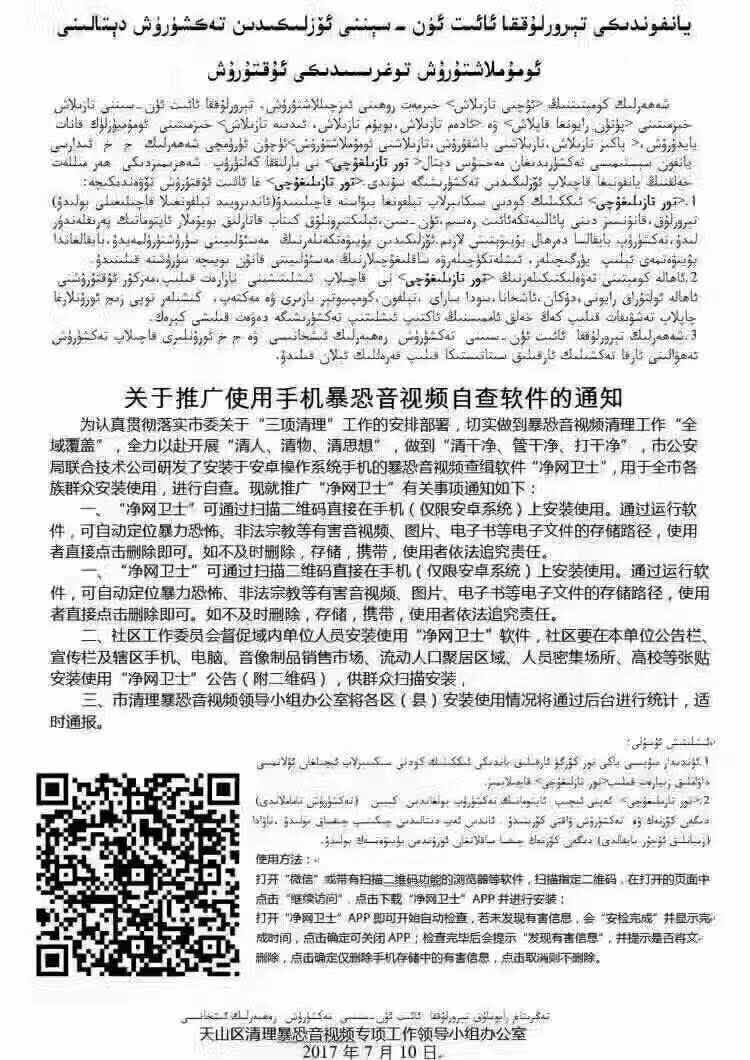
China Installing Spyware Muslim Minority
Image: Twitter
The Twitter users are also claiming that the people who would refuse to install the app or delete it, would be detained for up to 10 days.
View image on TwitterView image on TwitterView image on Twitter
新疆各部手机检查安装净网卫士官方软件,短信通知十日内安装,临检发现没安装拘留十天,科技倒退,逼老百姓用老年机,什么叫禁锢,这种全面监控就是禁锢。回到长毛时代
Just in case you are wondering about the things Chinese government wishes to achieve with the help of this app, it regularly scans the MD5 signatures of the media in the phone. That media is then matched with a stored database of the files classified as illegal and terrorist-related media.

The government had already taken other oppressing steps in the past, including the banning of veils and growing long beards.

Comments

Follow Us

WHAT'S HOT

Facebook Trying To Get Rid Of Fake, Low-Quality Live Videos

Facebook is updating its Live guidelines to limit the reach of fake and low-quality content. It's explicitly disallowing publishers from posting prerecorded videos as if they're livestreams and it also won't allow for static/looping images or livestreamed polls.

Poco F2 Pro 5G Officially Launched Globally With Snapdragon 865

After months of wait, Poco has officially launched Poco F2 Pro. The phone is a sequel to the Poco F1 which was a huge success for the company back in 2018. It is also the second Poco contender in 2020. In February, the Poco brand revealed a new phone lineup and launched Poco X2. The phone was priced at Rs 15,999 and featured similar specs of Redmi K30, a Xiaomi flagship that was launched back in 2018. The company has applied the same strategy for today’s launch. As we expected, Poco F2 Pro bundles all the specs of Redmi K30 Pro that Xiaomi launched last month. Poco F2 Pro Specifications, Availability and Price Unlike the Poco X2, the phone offers a circular camera at the back and a pop-up selfie camera at the front as opposed to the regular dual-hole punch cutout on the display of Poco X2. Poco F2 Pro comes with a 6.67-inch FHD+ AMOLED display with a 92.7% screen to body ratio. On top of that, the phone has an in-display fingerprint sensor to keep up with...

Windows Subsystem For Linux Is Beta No More, Gets “Full Support” In Windows 10 Fall Creators Update

As we told you earlier, WSL on Windows 10  moved out of beta  in August. It still carries the beta tag in Windows 10 Creators Update. Also, it won’t require people to enable developer

Steps To Enable Speech Recognition On Windows 10

The accuracy of speech recognition increases through use, and the feature adapts itself to a user’s grammar, word usage, speech patterns, and vocabulary.