
When Google launched Chrome OS in 2009, it did so with an aim to provide a simple, fast, secure, and no-nonsense operating system to its users. Thanks to Google’s push, Chromebooks have been making a killing in the education sector and turning out to be a
headache for Microsoft and Apple. They are low-cost, easy-to-set-up, and manage.
Apart from the education sector, Chrome OS and Chromebook adoption have also been witnessed in the business sector where these machines are used for different customer engagement practices. In this process, Google has received requests from the businesses regarding a single and centralized solution that would help them keep track of all their Chromebooks.
What is Chrome Enterprise?
Google has announced Chrome Enterprise to solve the problems of business owners. This beefed up Chrome OS version comes loaded with tons of features like access to enterprise app storefronts, security controls, 24×7 support, and integration with management tools, etc.
Chrome Enterprise features support for VMWare Workspace One, which is a popular platform for managing apps on user devices. This will combine the cloud-based management VMware AirWatch with the speed and security of Chrome.
With this new Chrome OS version, admins can also control what Android applications can be installed on Chrome OS devices.
The other features of Chrome Enterprise are printer management and managed operating system updates. This ensures a uniformity to all devices and brings better security with timely update installation.
How is Chrome Enterprise different from Chrome OS?
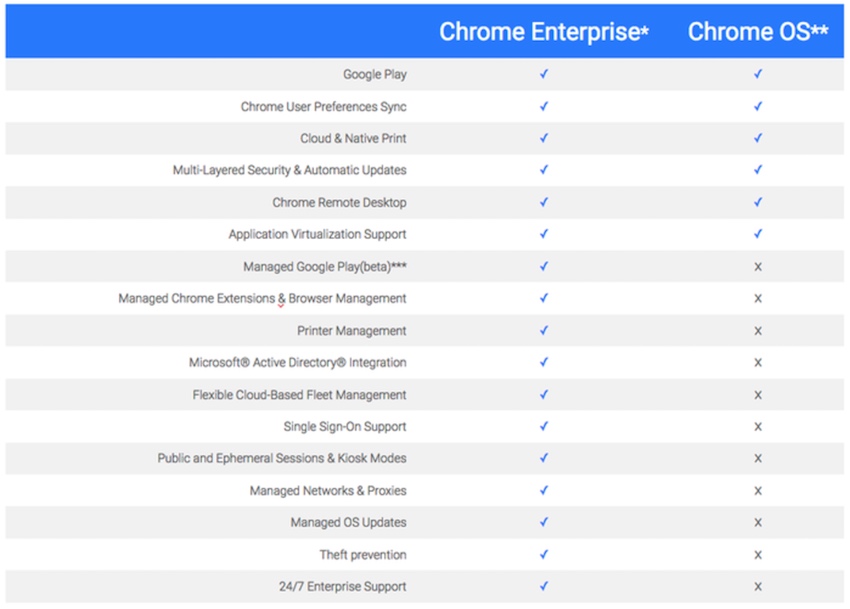
Chrome OS and Chrome Enterprise have a lot of common features like Google Play, Cloud and Native print, Automatic updates, Remote Desktop, and Application Virtualization.
The apps that are made for the enterprise set Chrome Enterprise apart. These features are Printer Management, Managed Google Play, Managed Browser and Extension Management, Single Sign-on Support, Managed OS Updates, Theft prevention, 24/7 support, etc.
You can take a look at this Chrome Enterprise vs Chrome OS comparison chart to get a rough idea:
The overall point of Chrome Enterprise is to attract the business sector and present Chromebooks as an appealing solution. It would be interesting to note how Google’s competitors will respond to this move and bring integration solutions to niches.
The subscription of Chrome Enterprise costs $50/device annual.
Comments
Post a Comment