
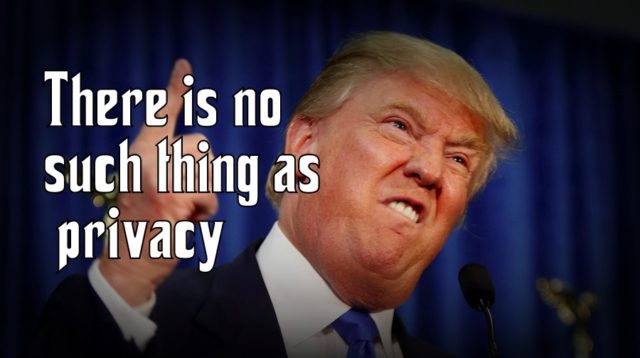
Donald Trump’s New Order Takes Away Data Privacy Rights From Non-Americans


According to the reports floating around, Donald Trump’s Executive Order, aimed at strengthening United States’ immigration laws, might pose a threat to the privacy rights of the European citizens. This order excludes non-US citizens from privacy policies as it
adversely affects the US-EU Privacy Shield, which allows companies to import their data to the US for processing.
The US-EU Privacy Shield, which went live in the year 2016, is about to get in the situation of turmoil. It might be because of an Executive Order signed by the President of the United States, Donald Trump.
“Privacy Act. Agencies shall, to the extent consistent with applicable law, ensure that their privacy policies exclude persons who are not United States citizens or lawful permanent residents from the protections of the Privacy Act regarding personally identifiable information,” reads Section 14 of the Executive Order.
The US-EU Privacy Shield is an authorization framework allowing US based companies to import and process the data of European citizens, but in compliance with the privacy norms set by the European Union. Currently, there are more than 1,500 such companies including Google, Facebook, Microsoft taking advantage of the privacy shield.
The Executive Order, which focuses on enhancing US domestic immigration laws, sets aside the privacy rights of the people who are “not United States citizens or lawful permanent residents.”
It may introduce cracks and put questions on America’s role in the authorization framework as it involves the transfer of data belonging to the EU citizens. The order may also make it harder to operate for companies leveraging the Privacy Shield.
What are your views on this Executive Order? Also, don’t forget to tell us your feedback.
Now Watch: Amazing Animation Videos That Are Awesome As Fu*k 

Comments

Follow Us

WHAT'S HOT

Facebook Trying To Get Rid Of Fake, Low-Quality Live Videos

Facebook is updating its Live guidelines to limit the reach of fake and low-quality content. It's explicitly disallowing publishers from posting prerecorded videos as if they're livestreams and it also won't allow for static/looping images or livestreamed polls.

Poco F2 Pro 5G Officially Launched Globally With Snapdragon 865

After months of wait, Poco has officially launched Poco F2 Pro. The phone is a sequel to the Poco F1 which was a huge success for the company back in 2018. It is also the second Poco contender in 2020. In February, the Poco brand revealed a new phone lineup and launched Poco X2. The phone was priced at Rs 15,999 and featured similar specs of Redmi K30, a Xiaomi flagship that was launched back in 2018. The company has applied the same strategy for today’s launch. As we expected, Poco F2 Pro bundles all the specs of Redmi K30 Pro that Xiaomi launched last month. Poco F2 Pro Specifications, Availability and Price Unlike the Poco X2, the phone offers a circular camera at the back and a pop-up selfie camera at the front as opposed to the regular dual-hole punch cutout on the display of Poco X2. Poco F2 Pro comes with a 6.67-inch FHD+ AMOLED display with a 92.7% screen to body ratio. On top of that, the phone has an in-display fingerprint sensor to keep up with...

Windows Subsystem For Linux Is Beta No More, Gets “Full Support” In Windows 10 Fall Creators Update

As we told you earlier, WSL on Windows 10  moved out of beta  in August. It still carries the beta tag in Windows 10 Creators Update. Also, it won’t require people to enable developer

Steps To Enable Speech Recognition On Windows 10

The accuracy of speech recognition increases through use, and the feature adapts itself to a user’s grammar, word usage, speech patterns, and vocabulary.